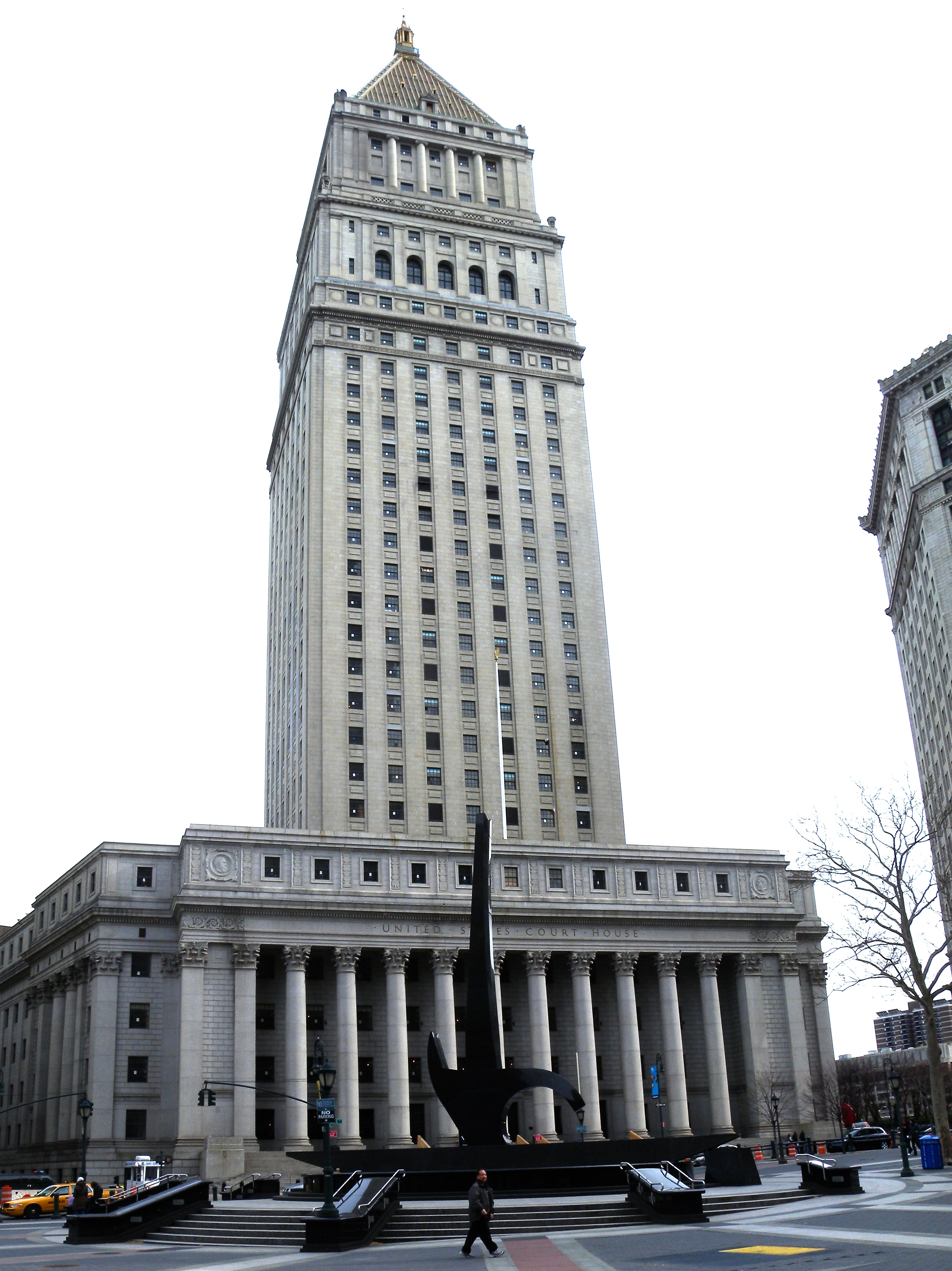
The Thurgood Marshall U.S. Courthouse on Foley Square, Manhattan — where the prosecution memo documented 38 victims but the charging analysis remains 98% redacted
The Case That Wasn’t
The prosecution memo documented 38 victims and multiple perpetrators. The Leon Black investigation accumulated three years of evidence. In both cases, the institutional answer was the same: decline.
On December 19, 2019, prosecutors in the Southern District of New York delivered an 86-page memo to their leadership. It documented 38 victims — 24 of them minors at the time of their abuse. It contained testimony from witnesses who described "hundreds" of young women passing through Jeffrey Epstein's residences. It included financial records from three banks, photographs seized under search warrants, and detailed accounts of obstruction by Epstein's inner circle.
The memo analyzed five individuals for potential charges. Only one was ever arrested: Ghislaine Maxwell.1
Named in the same document were men who raped, assaulted, or sexually exploited victims during directed encounters arranged by Epstein and Maxwell. Jes Staley was documented as having raped a victim during a massage, with JPMorgan communications corroborating the timeline.2 Leon Black was documented as having sexually assaulted a victim during a directed massage — then laughing it off.3 Glenn Dubin was documented as a recipient of Maxwell-directed sexual contact with a victim.4 None of them were among the five subjects analyzed for charges. None were ever charged.
What the prosecutors recommended doing about any of this is hidden. The charging analysis — pages 74 through 85 of the memo — is 98% redacted.5
The Memo
The prosecution memo (EFTA02731082) is the single most comprehensive document in the EFTA corpus. It was prepared for U.S. Attorney Geoffrey Berman and laid out, in methodical detail, what the government knew about Epstein's operation and who was involved.
The evidence was organized by category:
| Category | Scope | Source |
|---|---|---|
| Minor victim interviews | 24 victims, ages 13-17 at time of abuse | pp. 2-24 |
| Adult victim interviews | 14 victims | pp. 28-35 |
| Non-victim witnesses | 4, including a house manager who described "hundreds" of girls | pp. 36-38 |
| Subject interviews | 3 profiled subjects with detailed proffers | pp. 38-54 |
| Search warrant results | NYC and USVI residences; "extraordinarily large amount of data" | pp. 61-67 |
| Financial records | JPMorgan, Deutsche Bank, TD Bank productions | pp. 65-67 |
| Obstruction evidence | Witness payments, evidence destruction, attorney interference | pp. 40-41, 49, 51-52 |
This was not a thin case built on a single witness. It was a comprehensive prosecution package — 38 victims, physical evidence, financial records, and documented obstruction — prepared by a team of career prosecutors and FBI agents.1
And yet the scope of the charging analysis was narrow. The five subjects analyzed in Section IV were: three redacted individuals (described as assistants and a girlfriend), Lesley Groff, and Ghislaine Maxwell.5 Every one of them was part of the operational infrastructure — the schedulers, facilitators, and co-conspirators who kept the enterprise running.
Not one of the men documented as perpetrators of sexual violence was analyzed for charges.
The Redacted Pages
The charging analysis begins at page 74. From there to the end of the document, the text is almost entirely blacked out.5
Only the structural skeleton survives:
- Section IV.A analyzes Redacted Subject A — with visible subsection headers on "Knowledge of Sex Acts" and "Knowledge of Age"
- Section IV.B analyzes Redacted Subject B — fully redacted
- Section IV.C analyzes Redacted Subject C — fully redacted
- Section IV.D analyzes Lesley Groff — the header is visible, but the one-page analysis is completely redacted
- Section IV.E analyzes Ghislaine Maxwell — one footnote survives, confirming the prosecutors anticipated "recommending transportation of minors charges against Maxwell"6
The redaction is justified under deliberative process privilege and grand jury secrecy. These are legitimate legal bases. But the practical effect is striking: the public can read, in granular detail, what happened to 38 victims. What the government proposed to do about it is invisible.
Maxwell was arrested on July 2, 2020. She was convicted on December 29, 2021, on five of six counts. No other individual documented in the prosecution memo was ever charged.1

The Leon Black Investigation
If the prosecution memo represents a failure of scope — evidence gathered and then narrowly applied — the Leon Black investigation represents a failure of will. Over three years, prosecutors were presented with a steady accumulation of evidence. At every stage, the institutional response was the same: decline.
The timeline begins in April 2021, when a victim's attorney first contacted the SDNY.7 Within weeks, prosecutors had received FBI interview reports and bank statements showing wire payments from Leon J. Black, the J. Black Trust, and the E Trust — ranging from $15,000 to $167,000.8
One month after receiving the bank statements, the assessment came:
"I'm not inclined to open."9
That was May 28, 2021 — five weeks after the first contact. The evidence would continue to arrive for three more years. The answer would not change.
The Evidence That Kept Coming
In August 2021, a second victim came forward. The accounts matched: identical signature violence, described by prosecutors as "almost a perfect match."10 An internal email noted the response should be calibrated "so it doesn't seem like we are just rebuffing the victim."11
By January 2022, the position hardened: "not likely to open another investigation."12
The Manhattan District Attorney's office, which was actively investigating, kept bringing evidence to SDNY's attention. In May 2023, they presented accounts from three victims — documenting violence, sexual assault with objects, and a reference to a victim "being 10" years old.13 In June 2023, DANY prosecutors told SDNY they "do not doubt" the victim's allegations and identified "potential targets."14
On July 22, 2023, the Civil Rights Unit — the SDNY division specifically responsible for sex trafficking prosecutions — issued a formal decline: "doesn't intend to open."15
On August 1, 2023, the final institutional sign-off: "Agree with DTC."16 Decline to Charge.
"I Did Not Write Anything Up"
In December 2023, the AUSA handling the case explained a delay in response: "Sorry, I have been on trial."17 The case that wasn't had been waiting behind cases that were.
Then came the most significant admission in the entire record. The original AUSA — the prosecutor who had received the bank statements, interviewed the victim, and reviewed the corroborating accounts — was asked about a formal assessment of the evidence:
"I did not write anything up on Leon Black and the only victim we interviewed was [redacted]."18
In a federal prosecution office, writing something up is the mechanism by which evidence becomes a charging recommendation. It is the step that transforms witness accounts and bank records into a document that travels up the institutional chain for decision. Without a written assessment, the evidence was never formally evaluated.
The prosecutor who held the case for three years never put pen to paper on whether charges were warranted.
The Journals
The evidence did not stop after the formal decline.
In March 2024, the victim's journals were transferred to SDNY — handwritten accounts maintained over four years while the victim was being trafficked, written in code, naming more than 30 abusers including Leon Black.19
The prosecutor's reaction: "I read these." Then: "Interesting but v complicated." Then: "I reviewed everything."19
On March 15, 2024, the victim testified before Judge Rakoff. In April and May, the journals underwent forensic authentication. The results were definitive: written in gel pen, consistent with the time period claimed, no evidence of fabrication.19
On May 30, 2024, the authentication results were briefed to SDNY. The last documented communication is August 1, 2024 — a JPMorgan distribution order. The victim wrote a letter to the court.20
On January 30, 2026, Dataset 12 was released to the public under the Epstein Files Transparency Act. Zero charges had been filed against Leon Black.
The Pattern
The two failures are distinct in mechanism but identical in outcome.
The prosecution memo failure was one of scope: prosecutors had evidence against multiple named perpetrators but analyzed only the operational infrastructure for charges. The men who committed the violence were treated as context, not targets.
The Leon Black failure was one of inertia: evidence arrived in a steady stream — bank statements, multiple victims, forensic authentication — and at each stage the institutional response was to decline. The language evolved, but the answer never changed:
- May 2021: "not inclined to open"9
- January 2022: "not likely to open another investigation"12
- July 2023: "doesn't intend to open"15
- August 2023: "Agree with DTC"16
Four formulations. One outcome. Zero charges.
Leon Black's personal wealth is estimated at $10 billion. He retained Dechert LLP for the investigation response. He paid $158 million in settlements — including $62.5 million to the U.S. Virgin Islands. He hired Brad Edwards, formerly one of the victims' own attorneys.
The prosecutors, meanwhile, were handling active caseloads. "Sorry, I have been on trial."17
Whether this resource asymmetry influenced the outcome is an inference. That it existed is a documented fact.
What Remains Hidden
The prosecution memo's factual sections are a matter of public record. The Leon Black investigation's institutional communications are a matter of public record. Between them, they document what the government knew and what the government decided.
What they do not document is why.
Why were the men who committed sexual violence excluded from the charging analysis? Why did the original AUSA never write a formal assessment despite three years of accumulating evidence? Why did the Civil Rights Unit decline to open a case after receiving forensically authenticated victim journals?
The answers to these questions, if they exist in written form, are either redacted or were never committed to paper. The prosecution memo's charging analysis is hidden behind deliberative process privilege. The Leon Black case has no written assessment at all — because, as the AUSA admitted, he never wrote one.18
The evidence is in the public record. The accountability is not.
This story is sourced from documents released under the Epstein Files Transparency Act. For the complete analytical report, open questions, and full source document register, see the [source case file](/case-files/prosecutorial-failure).

Get help building custom platforms, AI-powered tools, and data-driven applications for your business or projects.
This article is based on documents released under the Epstein Files Transparency Act (EFTA). All claims are sourced to specific EFTA documents identified by Bates number. Entity tier classifications reflect evidence strength, not legal determinations.
Research and initial drafting assisted by Claude AI (Anthropic). All articles are reviewed, fact-checked, and edited by Derek Emsbach.
Continue Reading
Related investigations

The System
Five interlocking components — financial incentives, governance control, witness suppression, beneficiary alignment, and prosecutorial inaction — produced one outcome: the evidence is in the public record, the accountability is not.

The Trustee With No Exit
Jes Staley signed the Epstein trust three times, retained Epstein as a banking client after his conviction, and was documented by prosecutors as having raped a victim during a directed massage. No resignation from the trust has been found. No charges have been filed.
The Billion-Dollar Blind Eye
Three victims. Forensic journals. Bank records. A $62.5 million settlement. A $158 million relationship with Epstein. And an AUSA who admitted: "I did not write anything up on Leon Black."
Curious what Epstein and his network talked about?
A community-built email archive spanning years of private correspondence within the Epstein network.
Explore the Archive →