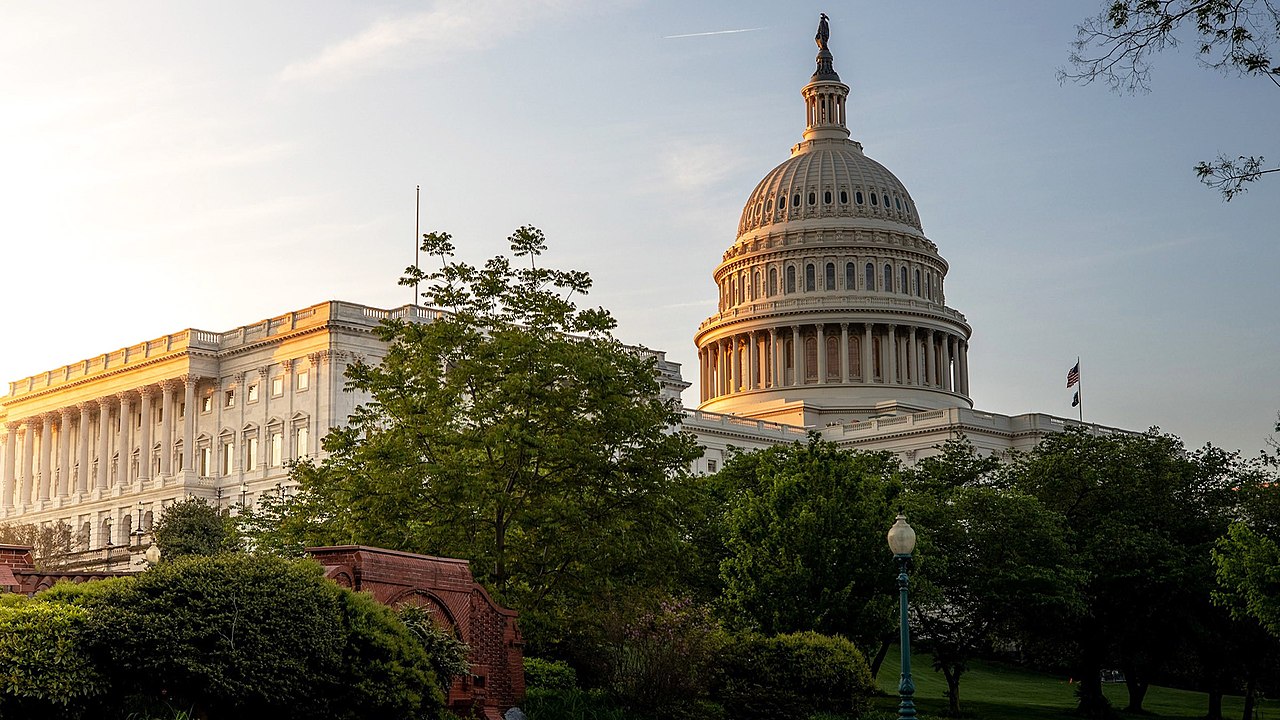
The United States Capitol — where George Mitchell served as Senate Majority Leader from 1989 to 1995. After leaving office, he maintained a relationship with Jeffrey Epstein that continued years after Epstein's conviction.
She's Here
An FBI 302 documents a Brazilian victim sent by Jeffrey Epstein to former Senate Majority Leader George Mitchell at two luxury hotels — the Beverly Hills Hotel and the Four Seasons in Washington, D.C. Mitchell was on the phone with Epstein when she arrived. Fifteen scheduling documents show the relationship continued for years after Epstein's conviction. Mitchell was formally listed as a witness with "knowledge of sexual trafficking conduct." No law enforcement agency has interviewed him.
The woman arrived at the Beverly Hills Hotel and was taken to a presidential suite. Inside, a man was on the phone with Jeffrey Epstein. He introduced himself as George Mitchell. He told her she would be staying with him in this room.1
She did not know who he was. She knew only that he was a friend of Epstein's, and that Epstein had sent her there.1
George Mitchell was seventy-one years old — a former United States Senator, former Senate Majority Leader, the man who brokered the Good Friday Agreement in Northern Ireland. She was twenty-eight, a Brazilian immigrant whose English was still poor, living in an apartment Epstein paid for on East 66th Street.1
When she walked into the room, Mitchell said into the phone: "She's here."1
Two Hotels
The FBI interviewed the victim by video conference on August 21, 2020. Two AUSAs, a detective, and a special agent conducted the interview. The resulting FD-302 report survives in the EFTA corpus in two versions — one from Dataset 9 with heavier redactions, one from Dataset 12 with names restored.12
Her account of Mitchell describes two encounters at two luxury hotels in two cities.
Los Angeles. Epstein told her she was going on a vacation. He booked a trip to Los Angeles and said she would be meeting people there. At the Beverly Hills Hotel, Mitchell and she went for a walk and went shopping. They returned to the hotel and had dinner. Mitchell asked for a massage. Then he asked for a blow job and sex. She complied. She did what she was told.1
The next day, Mitchell told her to stay at the hotel. She waited by the pool, then returned to the room. Mitchell wanted to have sex again. Then they went shopping for suits. Back in the room, Mitchell wanted sex two more times.1
When she returned to New York, Epstein told her she was doing very well and that Mitchell was a good friend of his.1
Washington, D.C. Before she left the country, Lesley Groff — Epstein's longtime scheduler — arranged a train trip to Washington. The victim took the train from Penn Station. Epstein called during the trip to check on her.1
She arrived at the Four Seasons Hotel and went to the front desk. They told her there was no reservation in her name. She waited in the lobby. Mitchell walked in, approached her, and told her to come with him. They went to his room. He said she was going to stay with him.1
Mitchell wanted to shower with her. He wanted a blow job and sex. The next day, Mitchell had sex with her again, then left for work. She walked around the hotel alone. She told the FBI that Mitchell had suggested she go to a museum — but she was too embarrassed to tell him she had no money, so she walked around the block and came back to the room.1
She wrote Mitchell a note. It said she was leaving and wanted to go back to school. She went home.1
The next day, Epstein called. He was yelling — very loud, angry, and mean.1

The Mechanism
The 302 reveals a specific operational pattern. The victim did not contact Mitchell. She did not know who he was. She did not arrange travel, lodging, or logistics. Every element was coordinated by Epstein's office.
Epstein selected the victim. Lesley Groff booked the travel. Epstein called during transit to monitor her location. Mitchell was waiting at the destination, already on the phone with Epstein. There was no reservation in the victim's name — because the room was Mitchell's. She had no money, no local contacts, and limited English. She had nowhere else to go.1
The victim told the FBI she never reported the encounters. She was scared. In her mind during the Washington trip was the memory of a gun she had seen in Epstein's Palm Beach home — and the words another girl had told her: "You never say no to Epstein."1
This is the logistics of delivery. The scheduling documents in the corpus reveal the infrastructure behind it.
Number One on the List
The EFTA corpus contains a handwritten contact list found among Epstein's records. The first entry — number one — is "george Mitchell." The list continues with Leon Black, Bill Richardson, Jes Staley, Larry Summers, Harvey Weinstein, Michael Milken, Tom Pritzker, and others.3
A separate document from March 2012 shows Epstein maintained two seminar invite lists. The "Seminar-POWER" list included Bill Clinton, Bill Gates, George Mitchell, Michael Ovitz, and Howard Gardner. The "Seminar-MONEY" list included Jeff Bezos, Sergey Brin, Marc Andreessen, Eric Schmidt, Peter Thiel, and Jim Simons.4
Mitchell's placement on the power list — not the money list — reflects his value to Epstein: access, credibility, and political connections at the highest level.
The scheduling documents span 2010 through 2013 — years after Epstein's 2008 conviction and thirteen-month jail sentence. They show Epstein's office relentlessly pursuing contact with Mitchell:
- August 2010: "George Mitchell returned your phone call."5
- August 2010: Groff called Mitchell's office about a Yom Kippur dinner Epstein wanted to host, noting "it would mean a lot to you if the Senator could join you."6
- September 2010: Groff reported to Epstein, "I know you still have Senator Mitchell and Larry Summers on your radar... emailed Senator Mitchell's assistants several times."7
- October 2010: Groff emailed Mitchell's three staffers — Julia Reed, Janice Neal, and Maher Bitar — stating "Jeffrey Epstein would like to speak with Senator Mitchell."8
- January 2011: Epstein instructed Groff to "schedule George Mitchell to come see him and Peter Mandelson while Peter is in NY."9
- November 2010: Groff arranged for Mitchell to "stop by and sit down for a chat with you and Andrew" — a reference to Prince Andrew.10
- February 2013: Epstein wanted to arrange a lunch with Mitchell and Bill Gates.11
- November 2013: Mitchell had a 10:30 AM appointment with Epstein on the same day Epstein had a 2-5 PM meeting at Leon Black's office.12
The Back Channel
Mitchell's relationship with Epstein was not merely social. A deposition in the EFTA corpus reveals that Mitchell served as a trusted intermediary between Epstein and the financial world.
When Apollo Global Management — Leon Black's firm — needed to manage its relationship with Epstein, the strategy discussed internally was to use Mitchell as a diplomatic back channel. The testimony describes "Epstein and WR back channel to George Mitchell to preempt a blowup." WR was Senator Warren Rudman, who sat on Apollo's advisory board.13
The witness explained: "There was a belief that Jeffrey had a close relationship with George Mitchell and Senator Warren Rudman... also had a close relationship with George Mitchell. And we were trying to see if there was a possibility to create a dialogue by utilizing Mr. Mitchell."13
The "blowup" they feared was Epstein launching litigation against Apollo. Mitchell was considered trustworthy enough by both sides — the convicted sex offender and the billion-dollar private equity firm — to serve as the bridge between them.

What Everyone Knew
In a March 2011 memo marked "Highly Confidential," an AUSA listed the "important people" named by a victim. The list included Governor Bill Richardson, Prince Andrew, Alan Dershowitz, Senator George Mitchell, former Israeli Prime Minister Ehud Barak, Les Wexner, Ghislaine Maxwell, and Glenn Dubin. The memo noted that "encounters were videotaped by Epstein" and that the allegations were "consistent with information received during our investigation that Epstein made his millions by getting [information] on important people and blackmailing them."14
A June 2021 witness preparation memo for Juan Alessi — Epstein's Palm Beach house manager from the early 1990s through 2002 — listed the famous people who visited the property. Among them: "Mr. Trump, Senator George Mitchell, John Kennedy Jr., Alan Dershowitz... Prince Andrew and his wife."15
In legal proceedings related to the Giuffre v. Maxwell case, Mitchell appeared as witness number 53 on a formal witness list. The description: "Has knowledge of Ghislaine Maxwell and Jeffrey Epstein's sexual trafficking conduct and interaction with underage minors."16
At Maxwell's trial, she was asked directly about Mitchell. "Yeah, I do remember George," Maxwell testified. She said she was "friendly with his wife... Heather" and recalled traveling to Rome with Mitchell and his wife as a foursome — Maxwell, Epstein, and the Mitchells.17
Virginia Giuffre, in a separate account, said Mitchell "frequently visited Epstein's New York residence." She described him: "He is very clean-cut. You wouldn't think of him being part of Jeffrey's crew."18
The Diplomat's Silence
George Mitchell brokered peace in Northern Ireland. He chaired the Walt Disney Company. He led the investigation into steroid use in Major League Baseball. After leaving the Senate, he became U.S. Special Envoy for Middle East Peace under President Obama.
He has called the allegations against him "absolutely false." He has never been charged with any crime.18
But the FBI's own files contain a detailed account of a woman sent to him by Jeffrey Epstein — a woman who arrived at a hotel to find him on the phone with her handler, who was told she would be staying in his room, who had no money and no reservation of her own, and who wrote a note saying she wanted to leave and go back to school.
The scheduling documents show that after this, the relationship continued. Groff kept calling. Mitchell kept answering. The lunches with Bill Gates were proposed. The seminars were planned. The back channels were opened.
Witness number 53 on the list. Zero interviews by law enforcement.

Get help building custom platforms, AI-powered tools, and data-driven applications for your business or projects.
This article is based on documents released under the Epstein Files Transparency Act (EFTA). All claims are sourced to specific EFTA documents identified by Bates number. Entity tier classifications reflect evidence strength, not legal determinations.
Research and initial drafting assisted by Claude AI (Anthropic). All articles are reviewed, fact-checked, and edited by Derek Emsbach.
Continue Reading
Related investigations
The System
Five interlocking components — financial incentives, governance control, witness suppression, beneficiary alignment, and prosecutorial inaction — produced one outcome: the evidence is in the public record, the accountability is not.
The Case That Wasn’t
The prosecution memo documented 38 victims and multiple perpetrators. The Leon Black investigation accumulated three years of evidence. In both cases, the institutional answer was the same: decline.

The Trustee With No Exit
Jes Staley signed the Epstein trust three times, retained Epstein as a banking client after his conviction, and was documented by prosecutors as having raped a victim during a directed massage. No resignation from the trust has been found. No charges have been filed.
Curious what Epstein and his network talked about?
A community-built email archive spanning years of private correspondence within the Epstein network.
Explore the Archive →