
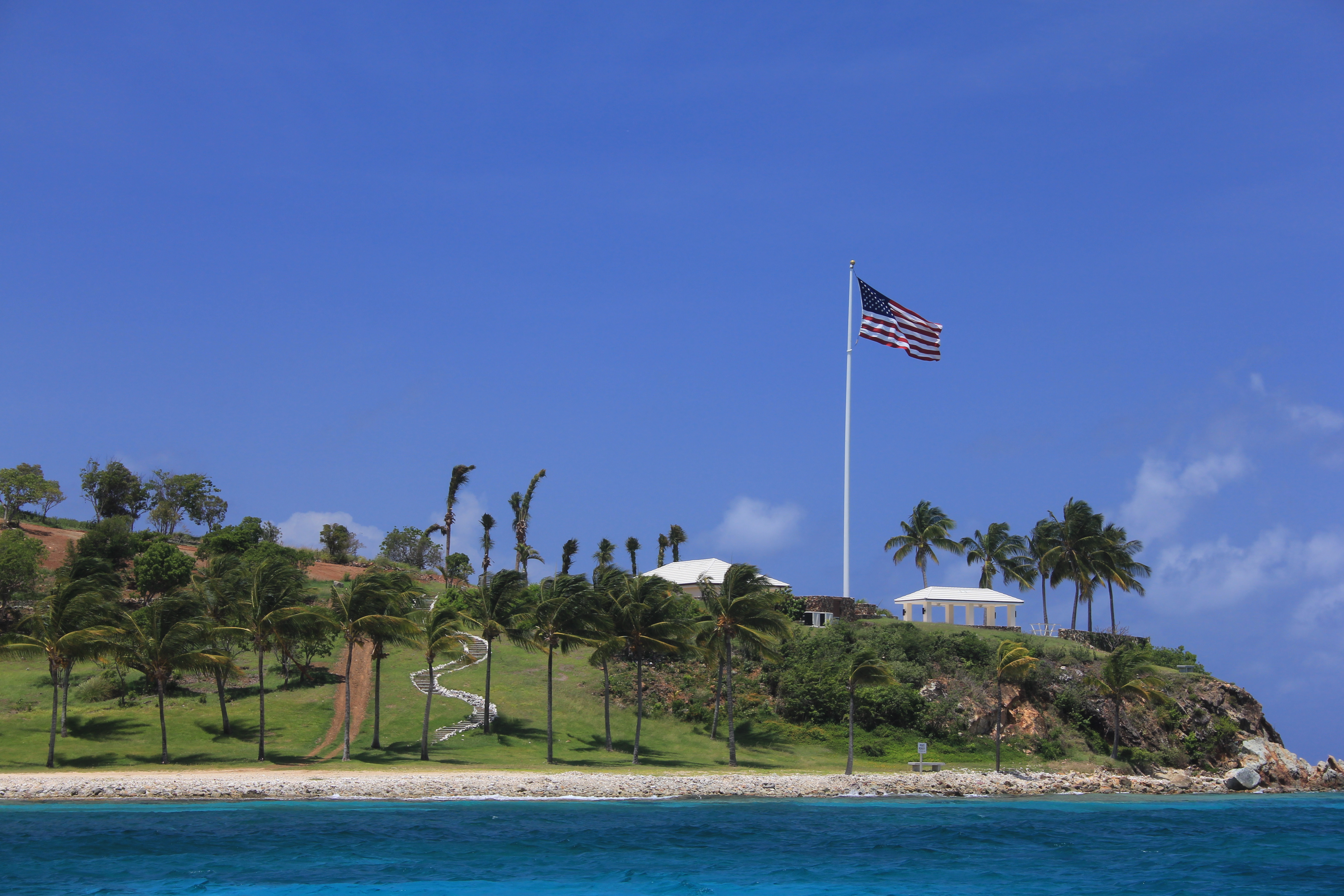
St. Thomas, U.S. Virgin Islands — where all 30+ Epstein shell companies were registered at the same address: 6100 Red Hook Quarter B3. The USVI registration concealed beneficial ownership across $577 million in assets.
The Architecture of Opacity
Two days before his death, Jeffrey Epstein signed a trust agreement transferring $577 million in assets to "The 1953 Trust" — managed by the same two men who controlled his 30+ shell companies. Buried in its provisions: a loyalty clause that threatened employees with losing million-dollar bequests if they were deemed "disloyal." It took the Southern District of New York eleven months to demand the estate promise not to use it against witnesses.
On August 8, 2019, Jeffrey Epstein sat in the Metropolitan Correctional Center in Manhattan. He had been arrested on July 6. He had been denied bail on July 18. He had allegedly attempted suicide on July 23. He had thirty-two days left to live.1
That day, he executed the most consequential financial documents of his life.
His attorneys brought him a trust agreement — an amendment and restatement of "The Jeffrey E. Epstein 2019 Trust," a document originally created on January 18, 2019, and already amended once on February 4. The trust was renamed: "The 1953 Trust," after his birth year. Into it, Epstein transferred everything he owned.2
He also signed a new last will and testament. Every asset — "all of my property, real and personal, wherever situated" — went to the acting trustees of The 1953 Trust.1
Two days later, he was dead.
The Labyrinth

To understand The 1953 Trust, you have to understand what flowed into it. Over the preceding two decades, Jeffrey Epstein had constructed a corporate labyrinth of more than thirty entities — shell companies, trusts, LLCs, and holding corporations — spread across the U.S. Virgin Islands, New York, Delaware, Florida, and France. Total documented value at death: $577,672,654.1
Every entity shared the same registered address: 6100 Red Hook Quarter B3, St. Thomas, U.S. Virgin Islands 00802.3
Every entity was controlled by the same five people: Darren Indyke, Richard Kahn, Erika Kellerhals, Harry Beller, and Lesley Groff.4
The architecture was not random. It was a system — designed to obscure beneficial ownership, prevent asset seizure, and ensure continuity of control beyond death. And it worked exactly as designed.
The Tree Names
Each major property was held by a separate USVI corporation named after a tree. The naming convention ensured that the word "Epstein" never appeared in any property record.1
The Paris apartment at 22 Avenue Foch — where French police would later seize computers, videos, and 4,500 emails referencing Jean-Luc Brunel — was held through SCI JEP, a French company in which Epstein owned 999 of 1,000 shares.2
The structure was not tax optimization. A single holding company would have accomplished that. This was something else: each property isolated in its own entity, so that a legal judgment against one could never reach another. The tree names kept the properties anonymous. The USVI registration kept the beneficial owner hidden.5
The Financial Core

Beneath the real estate layer sat the financial core: two entities that together held more than $400 million in investments.6
Southern Financial LLC was described by Deutsche Bank, its primary banker, as "formed to hold Mr. Epstein's personal wealth and invest in different ventures... invests in real estate, equities, commodities." Value at death: $163 to $176 million.5
Southern Trust Company Inc was the largest single entity in the estate. Value: $236 million.6
Around these two giants orbited a constellation of purpose-built vehicles. Hyperion Air LLC ($4.5 million) existed solely to "hold funds to pay for costs associated with an airplane owned by Jeffrey Epstein." Plan D LLC ($17 million) held the aircraft itself — formed October 19, 2012, with a stated purpose of "any lawful activity." Jeepers Inc was a sub-S corporation "managing various investments" — it sent $1.5 million to Epstein's personal JPMorgan account in a single wire transfer on July 15, 2013. Mort Inc held shares in a private company called Jawbone.578
Then there were the trusts. The Haze Trust was an "investment vehicle." The Butterfly Trust — an irrevocable trust with Harry Beller and Erika Kellerhals as co-trustees — held insurance policies; in 2016, Deutsche Bank's compliance team asked Richard Kahn what its purpose was, because "it is not cleared within the original trust agreement." The 2017 Caterpillar Trust held $13 to $15 million — until it was quietly wound down in April 2019, three months before Epstein's arrest.91011
Five People, Half a Billion Dollars
A document recovered from Deutsche Bank lists the authorized signers for every entity in what the bank called the "Southern Financial Relationship." The pattern is unmistakable.4
Epstein appeared on virtually every entity. Darren Indyke appeared on fifteen or more. Richard Kahn managed everything through HBRK Associates. Erika Kellerhals and Harry Beller administered the trusts. Lesley Groff had signing authority on Southern Financial LLC and the Caterpillar Trust.
No entity had an independent board. No entity had outside directors. No entity had external oversight of any kind. Five people — an attorney, a financial manager, a USVI corporate lawyer, an investment adviser, and a personal assistant — controlled half a billion dollars in assets with no checks on their authority.4
When Epstein died, control transferred seamlessly. Indyke and Kahn were already running everything. They simply added the titles "Co-Executor" and "Co-Trustee" to their existing roles.
The Loyalty Clause
The 1953 Trust was not just a wealth transfer document. Embedded in its provisions was a mechanism that federal prosecutors would later recognize as a potential tool for witness intimidation.2
Section 2.5(A) stated that no bequest to any employee or service provider would be distributed for two years after Epstein's death. Anyone who "voluntarily discontinues" employment or causes termination through "misconduct" within those two years forfeits their bequest entirely.2
Section 2.5(B) went further. It directed the trustees to "ensure that all persons who were employed by, or provided services to, me or any entity directly or indirectly owned by me" continue employment for two years. The list of grounds for termination included: "intentional misconduct, insubordination, breach of duty, disloyalty, dishonesty, fraud... criminal misconduct (whether or not pertaining to the assets in the Trust Estate)."2
The combined effect was elegant and devastating. Every employee was offered a life-changing bequest — ranging from $1 million to $10 million for staff members. But they would lose it all if they were deemed "disloyal" by the trustees within two years. And the trustees — Indyke and Kahn — had sole discretion to determine what constituted disloyalty.2
It took the Southern District of New York eleven months to address this. On July 26, 2020, an Assistant U.S. Attorney sent a letter to estate counsel demanding confirmation that Section 2.5(B) would not be used to retaliate against witnesses. Estate attorney Marc Weinstein, of Hughes Hubbard & Reed, responded the next day: the provision "has not been and will not be used by the Co-Executors to suggest that any current or former employee who chooses to meet or provide information to law enforcement... will be retaliated against in any way."12
The promise came. But it came eleven months after Epstein's death — eleven months during which every employee who might have known something was sitting on a bequest they could lose for being "disloyal."
The Beneficiaries
The 1953 Trust's bequest list reads like a personnel roster of Epstein's entire operation — with some notable inclusions.2
The largest named bequest: Karyna Shuliak — $50 million in cash, a $50 million annuity, all six properties (valued at $180 million), $5 million per property for operating expenses, a 32.73-carat diamond ring, and 48 loose diamonds. Total potential value: over $300 million.2
The operational core: **Darren Indyke ($50 million plus debt forgiveness), Richard Kahn ($25 million plus debt forgiveness), Ghislaine Maxwell ($10 million), Erika Kellerhals** ($2 million).2
The pilots: Lawrence Visoski Jr. ($10 million plus debt forgiveness), David Rogers ($4 million).2
The household staff: Bella Klein ($3 million), Luciano Fontanilla Jr. ($3 million plus a property in Valley Stream, New York), Merwin Dela Cruz ($3 million), Ann Rodriguez ($5 million).2
Ghislaine Maxwell's inclusion was striking. By August 2019, she was widely reported as Epstein's co-conspirator. She would be arrested eleven months later. Yet Epstein bequeathed her $10 million, "if she survives me." The SDNY later demanded — and received — a promise from the estate that no distributions would be made to Maxwell during her criminal proceedings.12
The Banking Trail

The entire shell company network banked through Deutsche Bank Trust Company Americas under the umbrella designation "Southern Financial Relationship." The primary relationship manager was Stewart Oldfield, a Director with CFA and CAIA credentials in the Wealth Management division at 345 Park Avenue.5
Deutsche Bank's own compliance teams classified the accounts as "high-risked." Periodic KYC reviews were conducted from Mumbai. The reviews dutifully noted the beneficial owner. They verified the authorized signers. They requested certificates of good standing. They continued banking.13
In 2016, when the compliance team asked what the Butterfly Trust was for, Richard Kahn told them to speak with Stewart Oldfield — because he had "already provided this information." The purpose of the trust was never documented in the file.10
Deutsche Bank would eventually pay $150 million to the New York Department of Financial Services for maintaining the Epstein relationship. But the bank's culpability went beyond passive negligence. Its wealth management team actively facilitated the architecture — processing wire transfers between entities, opening new accounts for trusts with undisclosed purposes, and conducting compliance reviews that documented the problems without ever resolving them.13
The Last Will
The will itself, signed the same day as the trust restatement, contained one additional detail that has received insufficient attention.1
The named executors were Darren Indyke and Richard Kahn. The named successor executor — the person who would take over if both of them were unable to serve — was Boris Nikolic.1
Nikolic was a Croatian-born venture capitalist and former science advisor to Bill Gates. His firm, BGC3, was named for "Bill Gates Catalyst 3." Email correspondence recovered from Epstein's accounts shows extensive personal contact between 2011 and 2014: social planning, mutual introductions, deal-making, travel coordination to Davos, Miami, and London. In one email chain, Nikolic, Kimbal Musk, and Epstein discuss Halloween costumes.14
Nikolic publicly declined the executor role after Epstein's death. But the naming itself — in a will executed two days before death — implies a level of trust and coordination that has never been publicly explained.
The Architecture
An internal DOJ email, sent days after the will became public, captured the situation with inadvertent precision: "As for where his assets actually go, it all goes to the 'acting Trustees of the 1953 Trust' — i.e., nobody is named herein."15
Nobody was named. That was the point. The architecture of opacity was designed so that even in death, the money would move through layers of abstraction — from a dead man's estate, through a trust named after his birth year, managed by the two men who had managed everything, distributed according to rules they wrote, on a timeline they controlled, in a jurisdiction they had cultivated.
The shell companies were not peripheral to Jeffrey Epstein's criminal enterprise. They were the infrastructure that made it possible — and the mechanism that ensured, even after his death, that the full truth would remain obscured behind thirty corporate veils at a single address in St. Thomas.

Get help building custom platforms, AI-powered tools, and data-driven applications for your business or projects.
This article is based on documents released under the Epstein Files Transparency Act (EFTA). All claims are sourced to specific EFTA documents identified by Bates number. Entity tier classifications reflect evidence strength, not legal determinations.
Research and initial drafting assisted by Claude AI (Anthropic). All articles are reviewed, fact-checked, and edited by Derek Emsbach.
Continue Reading
Related investigations

Normal for This Client
Deutsche Bank opened 76 accounts for a convicted sex offender, processed millions in payments to "ostensible foreign models" and co-conspirators, watched his attorney structure cash withdrawals — and when compliance flagged a wire to a Russian woman, the analyst wrote: "Once this type of activity is normal for this client it is not deemed suspicious."
The System
Five interlocking components — financial incentives, governance control, witness suppression, beneficiary alignment, and prosecutorial inaction — produced one outcome: the evidence is in the public record, the accountability is not.

The Scheduler
For eighteen years, Lesley Groff scheduled Epstein's "massages," booked victims' flights, and ran the daily logistics of a trafficking operation — from a law office. Prosecutors said her denials would not be credible. The charging analysis is entirely redacted.
Open-source research databases for the Epstein corpus
Community-built SQLite research databases covering concordance metadata, document alterations, image analysis, and handwriting records across 1.4M EFTA documents.
View on GitHub →